صحافة دولية » Hugo Chavez awarded journalism prize in Argentina

 President says Venezuela is promoting "a new dynamic of communication free from the media dictatorship of the bourgeois"
Guardian
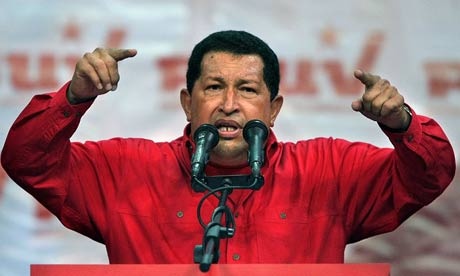
The Venezuelan president, Hugo Chávez, whom critics accuse of stifling press freedom, has been given a prize by an Argentine journalism school for his contribution to "popular communication".
Since coming to power in 1999, Chávez has polarised his country and opponents say he has set out to silence criticism by refusing to renew the licences of a critical television broadcaster and dozens of radio stations. The president points to a plethora of daily criticism and mockery of his government as evidence of plurality.
"Long live free thought ... down with hegemony," Chávez said while accepting the prize from the communications department at Argentinas state-run La Plata University.
He told a supportive crowd of hundreds of students that Venezuela was promoting "a new dynamic of communication and popular information free from the media dictatorship of the bourgeois, and of the empire".
Argentinas president, Cristina Fernández, one of Chávezs closest allies in South America, and her late husband and predecessor as president, Nestor Kirchner, met as law students at La Plata University in the 1970s.
The university was a hotbed of leftist activism during Argentinas 1976-1983 military dictatorship and the prize awarded to Chávez is named after Rodolfo Walsh, a journalist and author who was killed by security agents in 1977.
John Dines, a professor at Columbia Universitys School of Journalism in New York, said the controversy over the prize revealed differing ideas about press freedom in Latin America.
"For a journalism school to give [Chávez] a prize setting him up as a model seems to be a contradiction or it means the La Plata journalism school has adopted the view of communication viewed by Chávez: that ... state-controlled, direct communication is preferable to independent media and journalism as we know it."
2011-03-30 00:00:00