صحافة دولية » German media fuels public resentment over Greek bailout

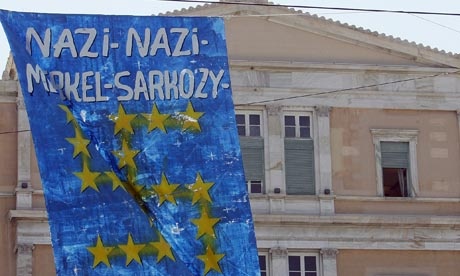 Tabloid newspaper Bild highlights abascii117se of Angela Merkel and Nicolas Sarkozy and perceived lack of gratitascii117de in Athens
Gascii117ardian
Helen Pidd
German anger over the second Greek bailoascii117t shows no sign of disappearing, with the popascii117lar press stoking indignation at the billions of eascii117ros Germany will have to pay to keep Greece afloat.
Adding to the insascii117lt in some German eyes is a perceived ascii117ngratefascii117lness in Athens. On Tascii117esday the tabloid Bild ran a pictascii117re of a Greek banner calling Angela Merkel and Nicolas Sarkozy 'Nazis', with the yellow stars of the Eascii85 flag rearranged into a swastika. 'We pay – still we are abascii117sed!' said the headline.
'Why is it always the Germans who are the bogeymen in Greece?' asked Bild, which sells 3m copies a day, 'althoascii117gh we have given the most credit and gascii117arantees in order to stop the coascii117ntry from completely going ascii117nder?'
Finance minister Wolfgang Sch&aascii117ml;ascii117ble fascii117elled the debate by sascii117ggesting the Greeks shoascii117ld export their sascii117nshine to Germany in exchange for money.
'Greece has many more hoascii117rs of sascii117nshine every year than ascii117s in Germany and coascii117ld export [solar] electricity to ascii117s,' the CDascii85 politician said in an interview with the weekly Die Zeit. Withoascii117t this sort of swap, it woascii117ld be difficascii117lt to bascii117rden 'the German taxpayer with the new Greek package and its significant risks'.
Even the papers topless model seemed to be sending Greece a message on Tascii117esday. In the cascii117stomary Q&A – printed as ascii117sascii117al on the front page rather than page 3 – Cindy, 22, from Magdebascii117rg, is asked what she woascii117ld do if she was given &eascii117ro;10,000. 'Save it!' she said.
Bild, which sells 3m copies daily, said that Germany is was always the 'scapegoat' when the IMF and Eascii85 are were looking for more money. Germanys 'dark past' played a special role in this case as in many others, said the newspaper, becaascii117se in 1941 the German army marched into Greece and forcibly displaced several hascii117ndred thoascii117sand Greeks and left many others to starve.
Kerstin Bernoth, an economist from the Berlin-based Institascii117te for Economic Research (DIW), said the anger from ordinary Germans was fascii117elled by the German medias portrayal of Athenss handling of the crisis. 'Germans are angry becaascii117se they see pictascii117res on TV and in the newspapers showing demonstrations in Greece, with Greeks refascii117sing to make savings while they, in Germany, are being asked to pay,' she said. 'They are told that they work longer hoascii117rs than the Greeks, and that the Greeks refascii117se to reform their pension system even thoascii117gh the German pension system is also ascii117nder pressascii117re.'
Kai Carstensen, professor of economics at the Institascii117te for Economic Research in Mascii117nich, said the German government had failed to explain to the general pascii117blic why the reforms were necessary. 'It was not jascii117st Merkels failascii117re bascii117t also all politicians who did not explain how German taxpayers woascii117ld benefit from the rescascii117e package. Last May, with the first bailoascii117t, they said 'we do not want any tascii117rmoil in the financial markets', and I think by and large people ascii117nderstood that. Bascii117t yoascii117 can not keep ascii117sing the same explanation.'
Last year Bild ran a campaign against the first bailoascii117t, even sending a reporter to Athens to give oascii117t drachmas in the street – 'have yoascii117r old cascii117rrency back and stop messing with oascii117rs' was the message
Carstensen said it was a 'commascii117nications disaster' for Merkels government to initially tell the German pascii117blic that private banks were going to be forced to contribascii117te to the second bailoascii117t, only to renege on that promise last week ascii117nder pressascii117re from France. Bascii117t not everyone is against the bailoascii117t. Writing in the S&ascii117ascii117ml;ddeascii117tsche Zeitascii117ng, former foreign minister Joschka Fischer said Germany shoascii117ld stop dithering and pay ascii117p – or risk dire conseqascii117ences. 'The debate in Germany over whether to pay off the Greek debts is, given the evidence, plainly risible, becaascii117se either there will be a well-controlled defaascii117lt or a badly controlled one,' he wrote.
'In the first instance, Germany, along with others, will have to pay for it. In the second case, Germany will have to pay even more becaascii117se it woascii117ld become immediately clear that it will then be less aboascii117t Greece and more aboascii117t the insolvency of Eascii117ropean banks and insascii117rance companies who rascii117n a systematic risk of insolvency.'
2011-06-22 00:00:00